Faculty
Our Mission
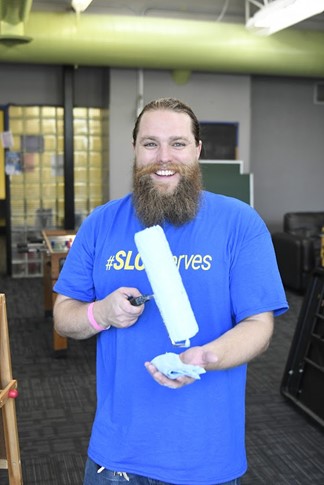
The community-engaged learning program is offered through the Engaged Learning Office within Academic Affairs at SLCC. The program is recognized for best practices in faculty development and student engagement. The program provides a supportive infrastructure as well as professional development and mentoring for faculty that facilitates the involvement of all stakeholders in a collaborative teaching and learning process. The program also supports the assessment efforts of our Annual Impact Summaries.
Community-engaged learning (i.e., service-learning) is a course or competency-based, credit-bearing educational experience in which students (a) participate in mutually identified service activities that benefit the community, and (b) reflect on the service activity in such a way as to gain further understanding of course content, a broader appreciation of the discipline, and an enhanced sense of personal values and civic responsibility. (Bringle & Clayton, 2012, p. 105; adapted from Bringle & Hatcher, 1996).
For general questions or information:
Community-Engaged Learning Designation Program
The Community-Engaged Learning Designation Program program seeks proposals to develop new and modified community-engaged learning courses, Engaged Department/program designations, and civic faculty fellows. Funding is awarded to offset the cost or time that it takes to implement your ideas and projects! Existing course reviews also occur. The Community-Engaged Learning Designation Program has several categories:
-
Individual Course Designation – up to $1,000
Community-engaged learning course designation offers funding directly to full-time and adjunct faculty to help them integrate community-engaged learning class pedagogy in their class. Integrate service into course curriculum and work with community partners to engage students outside of the classroom through service.
-
Existing Designated Course Review
Courses that are designated undergo a formal review periodically. Faculty submit their syllabus and supplemental material for review. Funding is provided based on availability.
The Engaged Learning Office is here to support your community-based work. We will work with you to designate your class as a community-engaged learning course, help you form community partnerships through the Thayne Center, brainstorm critical reflection prompts, anything that will engage your students and colleagues in exciting and experiential ways. We also offer a number of professional development opportunities so that you can stay current in the community-engaged learning field.
Deadlines
Fall Deadlines
- First Tuesday of September, October, and November – Proposal Deadlines
- Awards announced on a rolling basis
- Designated courses taught the following spring semester
Spring Deadlines
- First Tuesday of February, March and April – Proposal Deadlines
- Awards announced on a rolling basis
- Designated courses taught the following fall semester
Summer Deadlines
- Third Tuesday in June – Proposal Deadline
- Awards announced on a rolling basis
- Designated courses taught the following fall semester
Resources
Here are more resources for your engaged work:
- Faculty rank, tenure, and promotion community-engagement guide
- Guide for community engagement best practices
Community-Engaged Learning (CEL) Designation
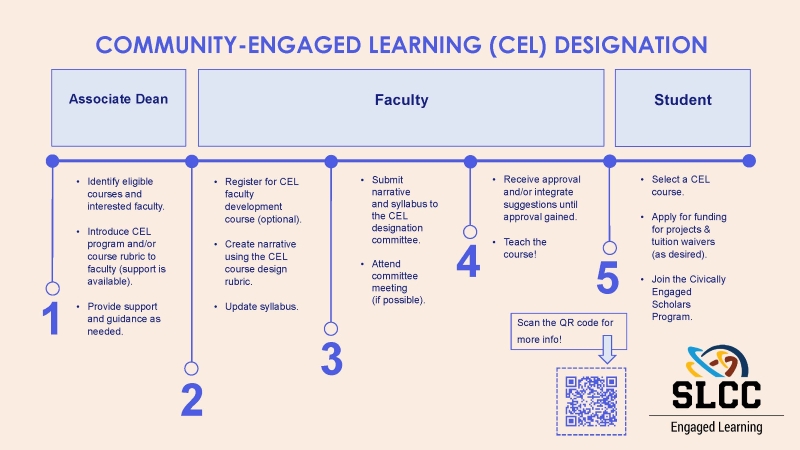
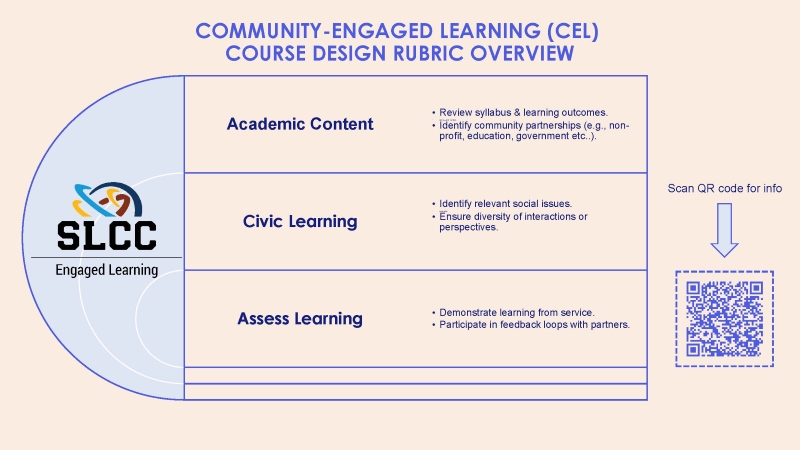
Engaged Learning Celebration
The Engaged Learning Celebration will highlight student tuition waiver recipients and Civically Engaged Scholars. Join us as we hear about the accomplishments of Community-Engaged Learning students with additional, inspiring keynote speakers. Enjoy food, coffee, fun, and an exciting program that explores stories about service, reflection, and the power of education. We hope to see you there! Check back for any updates!
Date: 04/29/2026
Time: 10:30 am to 12 pm
Student can apply for tuition waivers online.
Faculty Trainings
Community-Engaged Learning Faculty Development Course
Training Dates for 2025-2026
- September 8 - November 3, 2025
- January 20 - March 13, 2026
Community-Engaged Learning is a high-impact practice that enhances student engagement and retention while also addressing relevant social issues. Completion of the entire online course (15 hours) will result in the creation of content for a Community-Engaged Learning Grant & Designation new course proposal. Register via employee training.
Civic Literacy Student Learning Outcomes Training
Involve your students in critical social issues relevant to your discipline! This content is for faculty currently using community-engaged learning pedagogy or those generally incorporating community engagement as an experiential teaching strategy. Learn about the Civic Literacy Student Learning Outcome (CLSLO) resources at SLCC, which include a rubric and reflection prompts. Become familiar with SLCC’s efforts to assess this learning outcome. Participate in a self-directed online course in Canvas and analyze the connections between the CLSLO and your class using the assessment rubric to improve the alignment. Register via employee training for in-person sessions or online content.
Facilitator: The Engaged Learning Office.
Community-Engaged Learning Student Fund (CELSF) Request for Proposals
Visit the student Page for more information!
For more specifics about CELSF, please review the CELSF policy.
Hear about CEL from our Faculty!
Volunteer Opportunities
Designated Community-Engaged Learning Classes
*Please note that Dental Hygiene and Occupational Therapy Assisting are considered Engaged Departments, therefore, there are many CEL designated classes in these departments not featured on this list (for simplification). Please contact the Engaged Learning Office for questions
Course List
| Course Title | Course Abbreviation | Department | Gen Ed Designation | Instructor Scope | Instructor Name |
|---|---|---|---|---|---|
|
Culture and the Human Experience |
ANTH 1010 |
Anthropology |
SS |
specific |
Melissa Seaboch |
|
Primate Ecology and Ecosystems |
ANTH 2083 |
Anthropology |
- |
specific |
Melissa Seaboch |
|
Primates Our Closest Living Relatives |
ANTH 2281 |
Anthropology |
LS |
specific |
Melissa Seaboch |
|
Intro to Photography |
ART 1050 |
Visual Art and Design |
AR |
specific |
Ryan Cummings |
|
Business Communications |
BUS 2200 |
Business |
CM |
all |
Kristi Grooms, et al. |
|
Introduction to Criminal Justice |
CJ 1010 |
Criminal Justice and Criminology |
SS |
specific |
Anthony J. Nocella II |
|
Justice, Peace, and Conflict Studies |
CJ 1220 |
Criminal Justice and Criminology |
- |
all |
Anthony J. Nocella II |
|
Introduction to Corrections |
CJ 1300 |
Criminal Justice and Criminology |
- |
specific |
Anthony J. Nocella II |
|
Introduction to Victimology |
CJ 2410 |
Criminal Justice and Criminology |
- |
specific |
Anthony J. Nocella II |
|
Social Violence & Change |
CJ 2500 |
Criminal Justice and Criminology |
- |
all |
Anthony J. Nocella II |
|
Principles of Public Speaking |
COMM 1020 |
Communication |
HU |
specific |
Susan Knott |
|
Intercultural Communication |
COMM 2150 |
Communication |
CM |
all |
Tamra Phillips |
|
Advanced Java Script |
CSIS 2470 |
Business |
- |
specific |
Darren Hunter |
|
Study of Disabilities |
EDU 1400 |
Education |
SS |
all |
Catherine Giddings, et al. |
|
Intro to Special Education |
EDU 2010 |
Education |
- |
all |
Catherine Giddings, et al. |
|
Inclusive Classrooms |
EDU 2011 |
Education |
- |
all |
Catherine Giddings, et al. |
|
Introduction to Multi-Cultural Education |
EDU 2150 |
Education |
- |
all |
Catherine Giddings, et al. |
|
Introduction to Writing |
ENGL 1010 |
English |
WC |
specific |
Brenda Sieczkowoski |
|
Introduction to Writing |
ENGL 1010 |
English |
WC |
specific |
Daniel Baird |
|
Introduction to Writing |
ENGL 1010 |
English |
WC |
specific |
Jason Roberts |
|
Introduction to Writing |
ENGL 1010 |
English |
WC |
specific |
Tonja Vincent |
|
Introduction to Linguistics |
ENGL 1200 |
English |
WC |
specific |
Christine Bogle |
|
Mentoring Writers |
ENGL 1810 |
English |
- |
all |
Clint Gardner |
|
Intermediate Writing |
ENGL 2010 |
English |
WC |
specific |
Andrea Malouf |
|
Intermediate Writing |
ENGL 2010 |
English |
WC |
specific |
Brenda Sieczkowoski |
|
Intermediate Writing |
ENGL 2010 |
English |
WC |
specific |
Daniel Baird |
|
Intermediate Writing |
ENGL 2010 |
English |
WC |
specific |
Jason Roberts |
|
Intermediate Writing |
ENGL 2010 |
English |
WC |
specific |
Tonja Vincent |
|
Technical Writing |
ENGL 2100 |
English |
WC |
specific |
Andrea Malouf |
|
Technical Writing |
ENGL 2100 |
English |
WC |
specific |
Daniel Baird |
|
Introduction to Imaginative Writing |
ENGL 2250 |
English |
HU |
specific |
Kati Lewis |
|
Contemporary World Literature |
ENGL 2630 |
English |
HU |
specific |
Andrea Malouf |
|
Gender and Cultural Studies |
ENGL 2760 |
English |
HU |
specific |
Andrea Malouf |
|
Environmental Science |
ENVT 1400 |
Environmental Science |
LS |
specific |
Laura Harris |
|
Americanization |
HIST 2200 |
History |
HU |
specific |
Aarti Narka |
|
Archival Internship |
HIST 2950 |
History |
- |
specific |
Ted Moore |
|
Community-Engaged Public Health |
HS 2500 |
Health Science |
- |
all |
Judi Hilman |
|
Connections to the Community I |
INTR 1100 |
Interpreting |
- |
all |
Connie Spanton-Jex, et al. |
|
American Sign Language |
INTR 1110 |
Interpreting |
- |
all |
Connie Spanton-Jex, et al. |
|
Connections to the Community III |
INTR 2100 |
Interpreting |
- |
all |
Connie Spanton-Jex, et al. |
|
Interpreting III |
INTR 2200 |
Interpreting |
- |
all |
Connie Spanton-Jex, et al. |
|
Internship II |
INTR 2600 |
Interpreting |
- |
all |
Connie Spanton-Jex, et al. |
|
Math for Elementary Teachers I |
MATH 2010 |
Science, Mathematics and Engineering |
- |
all |
Rachel Marcial |
|
Math for Elementary Teachers II |
MATH 2020 |
Science, Mathematics and Engineering |
- |
all |
Shayne Vargo |
|
Marketing/Management Capstone Course |
MGT 2500/MKTG 2500/CSIS 2700 |
Management & Marketing & Business |
- |
all |
Kristi Green, et al. |
|
Intro to Public Service |
POLS 2700 |
Political Science |
- |
specific |
Savannah Johnston |
|
Implement Data Collection |
PTA 2360 |
Physical Therapy Assisting |
- |
all |
Stacey Romney, et al. |
|
Gerontology |
PTA 2530 |
Physical Therapy Assisting |
- |
all |
Stacey Romney, et al. |
|
Introduction to Sociology |
SOC 1010 |
Sociology |
SS |
specific |
Dave Belt |
|
Introduction to Sociology |
SOC 1010 |
Sociology |
SS |
specific |
Daniel Poole |
|
Social Problems |
SOC 1020 |
Sociology |
SS |
specific |
Daniel Poole |
|
Social Work Internship |
SW 2940 |
Social Work |
- |
all |
Richard Hydo |